
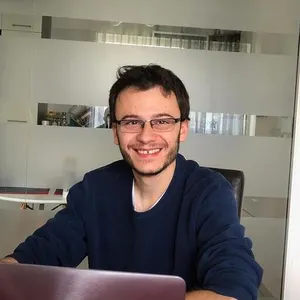
Andrei Radu (Founder & CEO, GPeC): “Affiliate marketing is growing, but I want to see it grow even faster”
Ahead of GPeC’s 20th anniversary, founder & CEO Andrei Radu reflects on two decades of Romanian e-commerce, market challenges, cross-border sales, and the growth potential of affiliate marketing.

20 years of GPeC. Many success stories, fond memories, challenges to overcome, speaker line-ups, and lasting partnerships. Who is best positioned to talk about it all? Andrei Radu, the founder of the event.
We sat down to talk with him because on May 27, GPeC turns two decades old. But also because affiliate marketing deserves a discussion alongside the most relevant people in Romania's e-commerce industry. People who witnessed the “beginnings,” as Andrei puts it:
“At the first edition in 2006, there were 150 participants. In Romania, there were about 400 online stores in total. And about 3-4 years earlier, in 2002, EMAG had launched—similarly, a store born out of passion. Three friends, one of them a medical student, who were passionate about hardware said: let's build an online store.”
If you want to meet us at GPeC at TNB, we also have a discount code for you when purchasing tickets: 2pfmnt
Read the full conversation with Andrei Radu as you scroll below.
______
The evolution of GPeC over the last 20 years.
It has been a great period, and it is an event we organize with passion. I think I’ve said this before at some point—I have the coolest job in the world because I make a living from this business and at the same time I thoroughly love what I do.
The event evolved alongside the market. Looking back at the first edition of GPeC in 2006, there were around 400 online stores in total in Romania, and some 3-4 years earlier, in 2002, EMAG had launched—back then, also a store born out of passion. Three friends, one of them a medical student, who were passionate about hardware and so on, said: let's build an online store. And look where EMAG is today.
So the first edition had few participants. There were around 150 of us, but they represented the entire industry—online store representatives, Visa, Mastercard, and payment processors.
We started GPeC as an awards gala. That’s where the abbreviation comes from; everyone asks us—what branding consultant did you work with to come up with such a peculiar name? In fact, it comes from the E-Commerce Awards Gala (Gala Premiilor e-Commerce), because we started as an awards gala, and when people wrote about us on blogs, they abbreviated it as GPeC.
We started adding learning modules, content, conferences, and so on. After that, from this perspective, we felt that the abbreviation GPeC better reflected reality—the gala remained just one component of the entire ecosystem, as we were no longer only an awards gala; we were also organizing conferences, workshops, and more.
And today we have reached this scale of an event series—meaning there are many events throughout the year: a winter school, GPeC Proficiency, which grew out of the online stores competition into an auditing and mentoring program for online stores, two editions of GPeC Summit, a summer school, and GPeC Republic of Moldova, having taken that step to Chișinău three years ago.
How do you identify trends from year to year, and how do they help you bring in speakers, set the agenda, and so on?
We are constantly connected to what is happening. We observe and stay in touch with online stores all the time, read about international trends, and research these topics. It’s impossible not to realize that AI is a major trend. And on the agenda for the GPeC Summit on May 27, most topics are related to AI in digital marketing, AI in conversion rate optimization, AI in user experience, and so forth. Because from my point of view, this trend is here to stay. AI today is just like the internet was a few decades ago.
Challenges
From an economic standpoint, the first negative shock was the 2008-2009 crisis, which was felt here as well. Purchasing power dropped, and companies cut their marketing budgets. Automatically, any event or company suffers.
Then there was a disorienting moment at the beginning of the pandemic, when we didn't know whether we would manage to hold the event or not. Nobody knew how long the pandemic would last. I admit that at first, I brushed it off a bit. I thought to myself: "Well, okay, it's happening in China, it won't reach us."
It wasn't until sometime in March that I realized it was going to be a long-term issue, even though it had started here around February. That was a pretty difficult moment when we had to say: "Okay, we have to postpone or cancel the May event—let's postpone it and see what we do moving forward."
But there was a silver lining there too: I discovered—and was moved almost to tears by the fact—that our traditional partners said: "We are still with you, hold the event online, we are not pulling out, we are moving forward together." It felt like family, standing together through thick and thin.
We used to have 35% year-over-year growth, which doesn't happen anymore right now. Today, we see more moderate growth averaging around 10%.
Top memorable moments in 20 years
At the first or second edition, we were knocking on the doors of sponsors and potential partners. Only one company said: yes, we will sponsor the event. That was FAN Courier. All the other companies at the time—some of which don't even exist anymore—refused. Everyone else told us, understandably in a way, and I get their reasoning: look, 90% of our shipments are envelopes and B2B documents. E-commerce is peanuts for us. And we kept telling them: yes, but this is going to be the future.
FAN is still our partner today, and I hope they continue to stay with us. Now, there are many courier companies partnering with GPeC because e-commerce truly represents a huge share of their business. The market has grown, just as I mentioned earlier—we grew together with the industry. That's what it's all about.
The categories of professionals attending GPeC today
They have changed over time. In the beginning, it was small and medium-sized online stores—eager to learn, eager to discover, apply new things, sell more, and grow their businesses. Meanwhile, with the pandemic, things shifted, and from my perspective, I'm glad they changed for the better.
I see increased interest from traditional retailers that operated offline businesses and realized during the pandemic that "we have to do something in digital, we can no longer rely purely on brick-and-mortar."
Since then, interest from these large companies has grown. We are talking about Big Pharma, traditional everyday retailers, and so on. Their interest has increased, and they are now part of the audience.
How do you perceive affiliate marketing right now? Its potential, markets, and so on.
It is growing. It seems to me that affiliate marketing is growing. What I don't like is that it's growing slower than I hoped. In other words, the adoption rate is still quite low in Romania overall, especially when I compare it to Western countries where affiliate marketing is one of the primary marketing channels.
Why do you think adoption is slower here?
I think it's a matter of market education. It's about timing and educating the market—explaining the benefits to people and helping them understand what affiliate marketing means and how it works. Very many businesses remain locked into classic channels—Google, Facebook, meaning Google and Meta ads, and email marketing—and they just stick to the same old recipe.
When you say people, do you mean stores or affiliates?
I'm referring to online store representatives who still don't see the real benefits of affiliate marketing.
Cross-border sales?
Very important. We have all insisted and pushed, saying: "Look, all online stores and sellers should start selling outside the country too." Because we see more and more merchants from outside Romania coming in and selling here. And we somehow need to return the "favor" and sell abroad as well.
People see the numbers and others' results, yet reluctance persists
Yes, that's what we notice too. And I know you constantly showcase numbers and results and so on, but there might also be an awareness and comprehension gap. On one hand, not fully understanding the concept—meaning nobody sat down with them to explain from start to finish how this works.
And secondly, it's also a matter of comfort zones. When you don't understand something, it seems overly complicated. So you say: "I'm not going to bother with this right now. Things work fine as they are. I'll stick to classic channels. I don't know how to do this—I'd have to talk to influencers, set things up, manage it all."
It's also a lack of resources
Guaranteed. You are completely right. Yes, it is also a lack of resources, especially for small and medium-sized businesses, many of which are family businesses. On one hand, it's great that they use SaaS platforms. That's totally fine—"I built my online store on this platform, everything works." SaaS platforms have evolved a lot in Romania; we no longer have the usability issues we had 10-15 years ago.
BusinessLeague in a word or a phrase
In one word, I find it exceptional. That would be the word. I think the concept is very well thought out, especially in terms of gamification and the overall structure.
You encourage fair competition among the entities participating in BusinessLeague and motivate each of them to push harder: “Let’s build, let’s make it happen!”
Final word
I would love to see as many people from the industry as possible at the 20th-anniversary edition. We have two editions this year, as always—one on May 26-27, and the other on October 14. And I would be thrilled for us to be together precisely for that family feeling.
I miss it every time GPeC approaches. It's such a great feeling when I'm on stage saying good morning and seeing so many dear people who have stood by us for so long and who represent the e-commerce industry. It's a wonderful feeling. I would be delighted to have you join us.
Articole Recomandate

Lucian Ionescu, Klikads.ro: “Other People’s Success Fuels Me”
From unloading trucks to ranking among Romania’s top marketers. Lucian Ionescu has done affiliate marketing since 2015, pioneered Google Ads in Romanian affiliate marketing, and is today a BusinessLeague Unicorn. We talked to him about money, mentorship, and affiliate marketing.

October Champions in Business League: €2,860 in Affiliate Prizes and 100% Network Commission Bonuses on Newcomers & Freelancers!
In October, the Affiliate Success team (Tudor, Alexandra, and Ștefan) awarded 15 performance prizes totaling €2,860 to affiliates who excelled in Active Relationships and Productive Relationships.

Gabriel Bonciu: “Affiliate marketing is 100% trust. Otherwise it doesn’t work”
He worked in media for over 15 years, then pivoted sharply toward affiliate marketing—meaning toward 2Performant. Lucky for us. So we sat down with Gabi Bonciu to talk about online stores, affiliates, trust, and what affiliate marketing means beyond commission.

BusinessLeague Pulse W44: Rankings, Numbers, and Round 3 Winners (October 26 – November 1, 2026)
187,971 sales (+4.4% YoY) and 5.66 million clicks (+25.4% YoY) at the close of BusinessLeague Round 3, plus 45,595 sales and 1.64 million clicks (+36.4% YoY) in Week 44. New Babies, Kids & Toys report, Black Friday eShop Challenges, and winners across all 22 categories.