
Gabriel Bonciu: “Affiliate marketing is 100% trust. Otherwise it doesn’t work”
He worked in media for over 15 years, then pivoted sharply toward affiliate marketing—meaning toward 2Performant. Lucky for us. So we sat down with Gabi Bonciu to talk about online stores, affiliates, trust, and what affiliate marketing means beyond commission.

From one Buzău native to another, I sat down for a chat with my colleague and friend Gabriel Bonciu, who over the past five years with 2Performant has lived through pandemics, crises, growth spurts, and enough sleepless Black Friday nights to write about them. And he actually does, in his Substack, “Beyond Cost-per-Sale” (“Dincolo de cost-per-sale”).
One of the classic questions I ask BusinessLeague players is how things have changed over the past x years since they started doing affiliate marketing. There are no right or wrong answers, but I liked Gabi’s in particular: the one who changed the most was him.
Over a coffee and a fresh orange juice with Gabi Bonciu, in the scrolls that follow.
Before affiliate marketing: 17 years in media and communications
Gabi’s journey didn’t begin in digital marketing. “B2B sales and client relations. Basically, that’s what I’ve done since 2004,” he says. He started at Mediafax, spent some time at Realitatea-Cațavencu with the NewsIn press agency, and between 2009 and 2021 worked at mediaTRUST in media monitoring. He sold services, handled client relations, and worked closely with communications professionals: PR specialists and both local and international agencies.
His first contact with affiliate marketing happened by chance. 2Performant became a mediaTRUST client, and Gabi—out of what he calls an “occupational hazard”—wanted to better understand what this company actually did. So he opened an affiliate account and ran his very first campaigns: around 50 RON in Google Ads.
Turning forty and a fresh start
He joined 2Performant in early December 2021, right after Black Friday. Just a few days earlier, on November 30, he had turned 40. “I felt the need to genuinely change something. And it was simply a new me.”
Back then, his relationship with e-commerce was that of a regular shopper who thought he knew a thing or two. Then came the revelation: there were countless online stores he had no idea existed. He remembers browsing Similarweb and realizing that one of the first stores he spoke with was Babyneeds, which had around 800,000 unique monthly visitors. He had young children at the time and had never heard of it. “Where had I been until now? In what parallel universe?”
Learning the ropes wasn’t hard for him. He went through a short but thorough induction with the help of Carmen, who was Head of Client Support at the time. His technical background also helped: he studied computer science in high school and used to build his own PCs from parts during college.
What has changed for online stores in five years
He joined in sales, and looking back at these five years, he believes he is the one who changed first—so today he asks the right questions much better. Online stores have changed too, pushed by the economic climate. They pay far closer attention to how they spend their money and to their margins, except that this caution has turned into something heavier:
More than caution, it has turned into a kind of fear. And this hyper-focus on how they spend their money translates into scaling back the dreams they are willing to take on.
I asked him whether, over these five years, the market has come to understand affiliate marketing better. His answer is categorical: “The only company that truly created an affiliate marketing market in Romania was us.” Even so, affiliate marketing still doesn’t hold the place it deserves in stores’ marketing mix. Gabi sees several reasons for that.
The first is misunderstanding the model: an entrepreneur doesn’t have the time to dive deep into this niche and needs a clear reason to keep going. The second is the convenience of asking third parties for advice. It’s natural for an entrepreneur to ask a digital marketer what they think about affiliate marketing, but the operating principles are completely different—so the recommendations are rarely the warmest. Affiliates end up being viewed as some sort of competition rather than a partner or a complementary channel. And on top of everything sits the fear of hidden costs.
Community Manager: stores and affiliates, face to face
Gabi’s role is to support the team of eShop Community Managers, who come from account management, support, or onboarding backgrounds.
The team is building what he calls “an whole new philosophy”: bringing stores and affiliates in the ecosystem into face-to-face dialogue much more often, so each side understands what the other does and how. He says he still feels the misconceptions stores have about attribution and about how affiliates actually do their work.
Behind affiliate marketing there is much more than cost per sale. There are many benefits that online stores don’t necessarily perceive.
Affiliate marketing is trust
No matter how far technology advances, Gabi believes, it’s still people who do business. “Affiliate marketing is 100% trust. Otherwise it doesn’t work.” I loved that line, so I put it right in the title. There are terms and conditions that set the rules, but you cannot contractually force anyone to bring you a certain amount of traffic or a guaranteed number of sales.
That’s also where his advice for online stores comes from. An affiliate won’t know your business unless you explain it to them. They will try to figure it out on their own, but without hints and insights into what sells and how, everything turns into a 100% automated relationship. Stores often treat affiliate marketing as a “not owned” channel and prioritize their own channels, which they feel they control. “But affiliate marketing can be controlled too, through a very well-structured program.” For that to happen, you need to get involved, understand what affiliates do, and pay genuine attention to this part of the business.
How “Beyond Cost-per-Sale” was born
Gabi’s Substack started with data: he discovered that he enjoys extracting numbers and turning them into an easy-to-digest format. AI also entered the picture—used as a learning tool rather than something to do the job for him. It helped him learn and structure his ideas, something that had long been a challenge for him.
Now the newsletter has a clear editorial plan. The first phase brings back the beginner-friendly content he wrote on LinkedIn to popularize affiliate marketing. Later on, Gabi wants to add interviews with affiliates and online stores, backed by platform data, and possibly video content.
The people in affiliate marketing he admires
I asked him to name three people. He chose from Romania because, as he puts it, each of them is sensational in their own way:
- Alin Vlad, from Otter. A huge data lover, involved in everything happening across the store, far beyond affiliate marketing.
- Ovidiu Golea. The top-performing affiliate on the platform.
- Lucian Ionescu. Countless people learned affiliate marketing from him, and he genuinely loves teaching others.
The list doesn’t stop there. Alex Foaie, founder of CashClub, is also an Affiliate Manager in BusinessLeague and promotes his project with tremendous energy. Among online stores, he mentions Andrei from Spring Farma and Vlad Rusu from GSMnet—noting that it took a while before they got started, but once they activated, “they took off like a rocket.” And Drago Draganov from Ozone, a store that Gabi believes deserves much more attention from affiliates: it has real potential and in Bulgaria it competes seriously with eMAG. What they all have in common: they invest time, stay open to dialogue, and don’t just reply when they need something.
His fifth Black Friday
For Gabi, this is his fifth Black Friday at 2Performant. Rather than a single store dominating Black Friday, as has happened in the past, he sees a redistribution of sales across multiple stores—because “that’s the direction the platform itself has been moving toward lately.”
Affiliate marketing is not a silver bullet
Will a store’s path to profitable affiliate marketing get shorter? “It should happen,” Gabi believes. But something else is even more important: building trust faster that affiliates are there to contribute to the store’s performance.
Affiliate marketing isn’t judged after one month, nor after three, he says. The BusinessLeague model helps stores evaluate their program after nine months. In the first three months, the entire network commission goes to affiliates. That’s followed by six months in which 50% goes to affiliates and 50% stays with the network. We give stores the opportunity to incentivize affiliates even further.
An online store shouldn’t look at affiliate marketing as a silver bullet or a miracle cure. What it does have is the opportunity to learn it: not just how the platform works, but how to build relationships with affiliates and what affiliate marketing truly means. “Like I said, it’s more than cost per sale. That’s what I expect to see: trust.”


Articole Recomandate


October Champions in Business League: €2,860 in Affiliate Prizes and 100% Network Commission Bonuses on Newcomers & Freelancers!
In October, the Affiliate Success team (Tudor, Alexandra, and Ștefan) awarded 15 performance prizes totaling €2,860 to affiliates who excelled in Active Relationships and Productive Relationships.

BusinessLeague Pulse W44: Rankings, Numbers, and Round 3 Winners (October 26 – November 1, 2026)
187,971 sales (+4.4% YoY) and 5.66 million clicks (+25.4% YoY) at the close of BusinessLeague Round 3, plus 45,595 sales and 1.64 million clicks (+36.4% YoY) in Week 44. New Babies, Kids & Toys report, Black Friday eShop Challenges, and winners across all 22 categories.
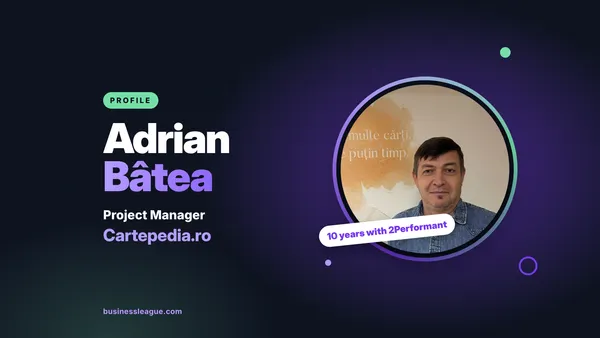
Adrian Bâtea (Cartepedia.ro): “Black Friday in Books is for readers who buy all year round: bigger discounts, free shipping or free books”
Cartepedia is celebrating 10 years with 2Performant. We sat down with Adrian Bâtea to talk about the book market and its readers, and about Cartepedia’s affiliate program, which has a huge amount of potential.
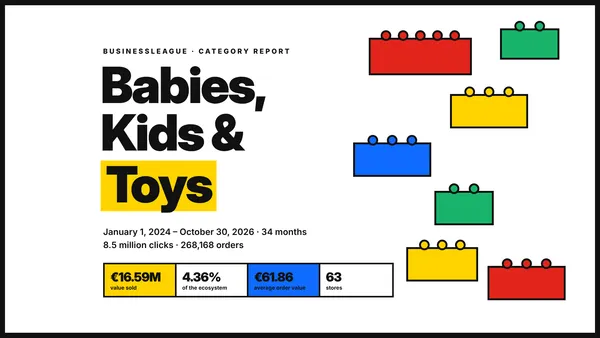
The “Babies, Kids & Toys” category in BusinessLeague: 268,168 orders (€16.59 million) in 34 months
Between January 1, 2024 and October 30, 2026, the Babies, Kids & Toys category brought 8.5 million clicks, 268,168 orders and €16.59 million