
Lucian Ionescu, Klikads.ro: “Other People’s Success Fuels Me”
From unloading trucks to ranking among Romania’s top marketers. Lucian Ionescu has done affiliate marketing since 2015, pioneered Google Ads in Romanian affiliate marketing, and is today a BusinessLeague Unicorn. We talked to him about money, mentorship, and affiliate marketing.
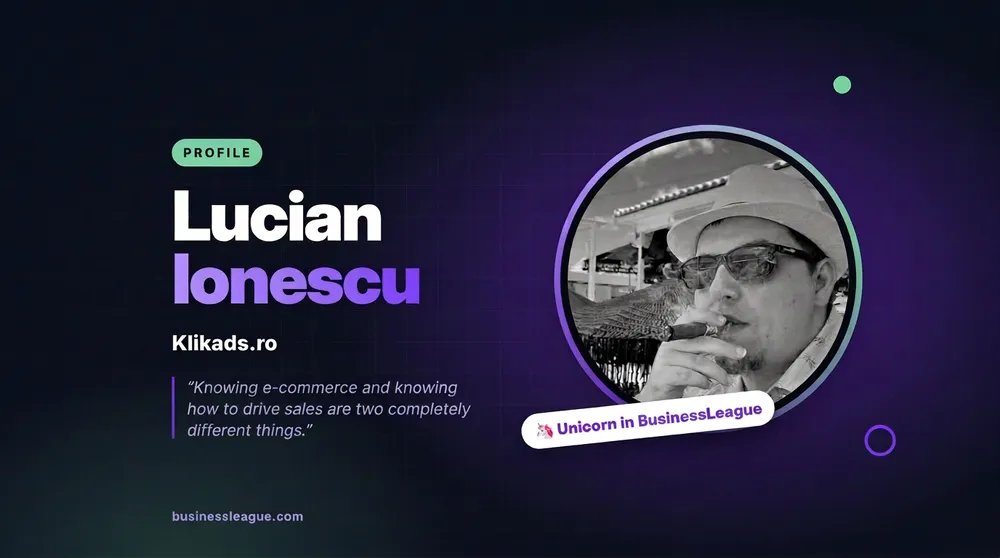
Some time ago, while I was still getting familiar with affiliate marketing and the top players in BusinessLeague, Dorin Boerescu told me that Lucian is a kind of Rafael Nadal around here.
As someone who has spent hundreds of days & nights watching the tennis champions of old, I’m usually skeptical of bold—not to say downright reckless—comparisons like that. Without spiraling into a web of metaphors you wouldn’t be able to pull me out of even with a crane, I’ll just say it wasn’t a reckless comparison at all: both sports and entrepreneurship produce individuals who excel at finding solutions, adapting, growing, and, more or less, not giving a damn about trends or “you have to.”
People used to say Nadal only knew how to play on clay—yet if that’s true, how did he become only the third player in history to win all four Grand Slams at least twice?
People also say that without traditional schooling you end up peeling potatoes your whole life—yet if that’s really true, how on earth do people like Lucian show up and win in marketing, poker, trading, and so much more?
Anyway, we’ll never run out of questions; what matters is never stopping looking for answers. Here are a few below.
No high school diploma, living on 650 RON a month
Lucian has been on his own since he was 17. He didn’t take his final high school exam (the Baccalaureate), even though he had been a math olympiad competitor. His very first job was loading and unloading trucks for a grocery store to pay his rent. Next came a factory job where he earned 650 RON a month (~€150 at the time)—or “six and a half million” in old Romanian currency. He worked his way up to a small supervisor role there, then clashed with a higher-level boss and walked out. Life moves fast sometimes.
The first office job and the obsession with learning
His first office job was at an IT company in Timișoara with over 500 employees. The company digitized historical documents from Germany: wills, deeds, and annexes, some dating back to the 1900s. Lucian started in OCR, manually transcribing what he saw on his monitor, and climbed role by role all the way to team leader.
“Leaving the factory and landing here felt like I had caught God by the foot.”
He threw himself into the entire project and taught himself programming just to finish the work faster. Eventually, managers and owners gave him complete freedom: he knew everything, from workflows to finances. Practically speaking, he was an intrapreneur.
That’s also where he met Roxana, his partner of 11 years. She had graduated in marketing. One day, at her place, Lucian saw her coursework on branding and color psychology and wondered whether people actually buy things when you apply those principles. His answer to himself was “yes,” and he got to work.
That led him to research how to promote an online store they had launched together. His method of learning has been the same since childhood:
“When I want to learn something, I become obsessed with it.”
Whenever he comes across a term he doesn’t know, he looks it up. Then he looks up every new term inside that explanation—for instance, “URL” and then “URL parameters”—three levels deep. He keeps hundreds, sometimes thousands of browser tabs open, and he actually reads them. Until he grasps the underlying logic, he cannot stop. And just like that, I met the only person on earth who genuinely reads the tabs he leaves open for months 😄
Affiliate marketing: 700 RON in, over 4,000 RON out
While searching for ways to promote the store, he stumbled across affiliate marketing:
“I said to myself: man, no way. I don’t even need to build a store or hold inventory anymore.”
A blog post by Dragoș Bunea, one of the veteran affiliates, convinced him. Bunea wrote about a Black Friday contest where he had won 20,000 RON (~€4,500). Octavian Jomir, who was also doing affiliate marketing back then, was reporting €10,000 in revenue.
Lucian created his 2Parale account in 2015. Then he studied what the top affiliates were doing, saw that Octav was running Google Ads, and jumped onto the platform. The math seemed straightforward to him:
- check the keyword cost in Keyword Planner;
- know the average conversion rate for the category;
- calculate: at 100 clicks and a 1% conversion rate, you get one sale;
- all that’s left is making sure the margin stays profitable.
His very first campaign: 700 RON (~€155) invested and over 4,000 RON (~€900) in commissions—without knowing a single person in the industry. From there, he kept going. He learned how to build websites and started taking on clients as well.
Was it easy as a beginner? “No, it was hard. It was almost impossible.” Very few people succeed. Most quit quickly because it’s never a straight line up: you face downturns and plateaus, and that’s where you have to shift your mindset. On top of that, you have to deeply understand what happens behind the scenes and think like a small business owner:
“The money isn’t your money—it’s the business’s money.”
The Black Friday that cost him
Did he ever get carried away? Yes—right on his first Black Friday as an affiliate.
“I told myself: that’s it, I’m the king.”
He lost 10,000 RON (~€2,200, or “100 million old lei”)—roughly what he used to make in two months. “That was a wake-up call.” The next Black Friday went well, and he has been growing steadily ever since.
Today, he runs the same playbook every year. He describes himself as an “impact” affiliate: during Black Friday he pushes hard, scaling to volumes 5–7 times higher than normal. His very first commission ever came from BestValue, and Black Friday with them has performed strongly every single year since. This year he’s less optimistic, as a few advertisers with whom he used to generate significant revenue have left.
Number 1, and then something else
When 2Performant launched its leaderboard, Lucian was ranked #13. He set a goal to reach #1 within six months. He pulled it off and stayed in first place for two consecutive years, until the rise of CSS. Since then, he has consistently remained in the top 3.
Does he still feel the need to be #1? He says no. For him, chasing the #1 spot at all costs would mean losing money just to fight for rank. It’s a business decision, not an ego contest. His motivation has evolved too. Early on, he was driven by the constant urge to crack new problems. Now, with most of his operations automated, he feels he has reached maturity in affiliate marketing.
Mentorship: “Other people’s success fuels me”
Lucian has taught a lot of people how to do affiliate marketing—including through the BusinessLeague Mentorship program, which produced several standout performers.
“It gives me more satisfaction when someone else succeeds than when I succeed myself.”
He refuses to pick a favorite: he names them all. Many of them have climbed into the Corporations and Companies tiers of BusinessLeague. He partners with all of them in day-to-day life through joint ventures—because that’s what mentorship means to him.
Where does the story break down for those who don’t make it? At the pain threshold. Many say they’re willing to endure a tough stretch so things get better later, but along the way they also want it to be easy. Most give up mid-journey.
“I have never seen anyone—absolutely anyone—whose trajectory went only up.”
At the beginning, the broader market doesn’t even matter—whether there’s a crisis or a pandemic. When you’re generating your first 500, 1,000, or 2,000 sales, your volume is too small to be affected by macro e-commerce trends.
The mistake growing affiliates make
The most common mistake he sees is picking the wrong online store. Later, once an affiliate starts growing, they begin seeing enemies everywhere: the store that cut its commission, the platform, or another affiliate because of whom they’re “not making X amount anymore. Those things don’t matter.”
His advice is to zoom out and move on to the next task in front of you—not get stuck being a hater.
A toy store as a lesson
In 2022, Lucian tried standing on the other side of the table: he ran an online children’s toy store. It worked, though not as well as he had hoped, so he eventually stepped away from it. However, he learned firsthand what an e-commerce entrepreneur deals with every day, and ever since, he has been much better at helping his clients.
“Knowing e-commerce and knowing how to drive sales are two completely different things.”
How he picks an online store
He hasn’t added a new store to his portfolio in over six months. When he does, he never goes in blind. He calculates the EPC, the store’s revenue, and its affiliate potential. As a benchmark, affiliate marketing should account for 5% to 15% of an online store’s traffic sources, depending on the niche. If he sees a store sitting at 2–3%, he knows from experience roughly what he can achieve there with his budgets and tools.
2Performant compared to the rest
Lucian also does a bit of work on international networks such as CJ or Dognet. For him, the comparison isn’t even close:
- Transparency: on other networks, it simply doesn’t exist.
- Payout speed: on 2Performant, payment is fast. With an advertiser on CJ, money can take up to 168 days to arrive—while the affiliate is funding ad spend out of pocket the entire time.
- Security: prepaid advertisers guarantee that you actually get paid.
He believes affiliate marketing is still undervalued by online stores—especially mid-sized ones making between €500,000 and €2 million a year. Those stores get by on Google and Meta alone because there’s enough traffic there. The reason, in his words: “It works well enough as is.” Stores that have scaled past €5 million, by contrast, pull traffic from dozens of sources because they tested early and acted as pioneers.
He also understands why some merchants are hesitant about affiliates. Many stores try affiliate marketing for the first time on 2Performant and haven’t built the muscle of patience. With Google, a merchant has no one to complain to about how much a click cost; here, they do. The solution lies purely in the math: the commission has to be calculated just as carefully as unit economics on any other acquisition channel.
What’s next
Lucian believes affiliate marketing will remain fundamentally the same for at least another five years.
He points to his own trajectory. He excelled at Google Ads Search; then CSS arrived, and he adapted. Today, Search accounts for less than 15% of his sales. He believes top affiliates will adapt to any new technology because they understand the underlying mechanics of selling.
He views AI the same way he viewed CSS: the pioneers who moved first on CSS are still at the top of the leaderboard today. If a few years from now 5% of e-commerce sales flow through LLMs and ads inside ChatGPT, the first affiliates who embrace the technology and persist will likely be the top performers once again.


Articole Recomandate


October Champions in Business League: €2,860 in Affiliate Prizes and 100% Network Commission Bonuses on Newcomers & Freelancers!
In October, the Affiliate Success team (Tudor, Alexandra, and Ștefan) awarded 15 performance prizes totaling €2,860 to affiliates who excelled in Active Relationships and Productive Relationships.

Gabriel Bonciu: “Affiliate marketing is 100% trust. Otherwise it doesn’t work”
He worked in media for over 15 years, then pivoted sharply toward affiliate marketing—meaning toward 2Performant. Lucky for us. So we sat down with Gabi Bonciu to talk about online stores, affiliates, trust, and what affiliate marketing means beyond commission.

BusinessLeague Pulse W44: Rankings, Numbers, and Round 3 Winners (October 26 – November 1, 2026)
187,971 sales (+4.4% YoY) and 5.66 million clicks (+25.4% YoY) at the close of BusinessLeague Round 3, plus 45,595 sales and 1.64 million clicks (+36.4% YoY) in Week 44. New Babies, Kids & Toys report, Black Friday eShop Challenges, and winners across all 22 categories.
Adrian Bâtea (Cartepedia.ro): “Black Friday in Books is for readers who buy all year round: bigger discounts, free shipping or free books”
Cartepedia is celebrating 10 years with 2Performant. We sat down with Adrian Bâtea to talk about the book market and its readers, and about Cartepedia’s affiliate program, which has a huge amount of potential.