
Bogdan Modreanu (aka Mo.Marketing): “We Have a Clear Strategy, We Work with 350 Stores”
Ranked #3 among BusinessLeague Unicorns, Bogdan Modreanu speaks openly about profit, pricing, and why he doesn’t believe in too much talk. We’re lucky we caught him for a conversation 😄
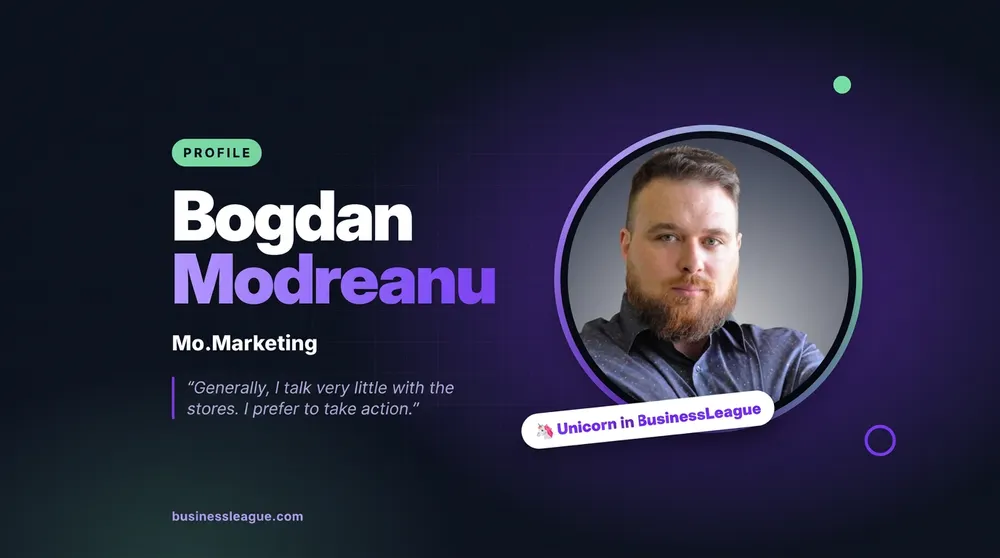
A stone’s throw from the neighborhood where I lived for about 10 years after college, I met up for coffee with Bogdan Modreanu—or Mo.Marketing, as players in BusinessLeague know him.
Our meeting was yet another reminder that while many people share the same goal, the paths they choose are often as different as green is from pink. It’s refreshing to see that in action, and affiliates are like a portal into pure performance.
For example, while hunting for little secrets and gems that make affiliate–store partnerships thrive, I asked Bogdan how important communication is. He told me it’s not really that important. As a communications guy, I took that one with a frown 😄—but top affiliates aren’t ordinary people; they’re extraordinary, and that naturally comes with different viewpoints.
Our full conversation—and what makes it intriguing—follows below.
Happy Black Friday, y’all!
School, by the scenic route
Bogdan says bluntly that school wasn’t for him. He made it to the math olympiad in ninth grade, didn’t continue, and switched high schools along the way. He also started several university degrees without finishing them. He comes from a family that was always trying things on its own, and he says that’s where he inherited his drive to experiment.
From Corel to publisher
His passion for computers started early, at a time when few kids had one at home. He’s from the same generation as me, so I remember those days well. His first serious job after moving to Bucharest was at a publishing house, doing desktop publishing and book layouts. He stayed there for a while, but the environment didn’t suit him.
Next came Hiparion, the publisher behind Căminul, Domus, and other home-and-garden magazines. There he found exactly what he needed: project-based work and a great team. He moved into marketing, designed layouts and banners, and then discovered Google Ads. The media group was acquired by a larger press conglomerate, and by his final year Bogdan had become a publisher, reporting directly to the CEO. Not too bad.
When the group collapsed and salaries stopped being paid, he left with the entire team he was managing—around 20 people. They rented an office space and started from scratch with their own magazines: no capital, just the clients and printing houses they already knew. It was, as he puts it, a huge adventure and maximum stress.
300 websites and fast-forward SEO
Around 2013–2014, Facebook was king, and clients didn’t really want print anymore (wait till you see 2026, young Bogdan of 2014!).
They moved everything online: across all channels they reached nearly 500,000 followers and built hundreds of niche websites, each dedicated to a single topic—from baby weaning to attic houses.
The mechanism was simple, because Google’s algorithm was simple back then too (ah, the good old days!): they would register a domain in the morning, upload a few hundred pre-written articles, point backlinks from their network, and by the next day they were ranking at the top. The sites were then monetized with clients paying monthly for banners and advertorials. Some of them are still around today, like Mama de Profesie, Concept Casa, or a website about tourist attractions in Romania.
When clients started running their own Google campaigns, Bogdan took over the PPC side as well.
The first Black Friday
Affiliate marketing also started in media. While he was still a publisher, back in the 2Parale days, he wrote several articles about Black Friday and the stores running deals and distributed them across the media group’s partner network. He made around 10,000 lei (~€2,000) back then. That was when he realized, “this is a pretty good business.”
All programs, the same strategy
“We launch all programs in BusinessLeague; we use a common strategy across all of them, at least at the beginning.”
Bogdan doesn’t cherry-pick stores by vertical. He applies the same strategy everywhere. The only constraint was time: at the start, campaigns require analysis, setup, and conversion tracking, so he worked his way top-down through the stores that accept CSS. Today he runs campaigns for all of them—around 350 stores, meaning every single advertiser that allows Google Ads and CSS.
He starts with small budgets, watches the metrics, and optimizes, just like any self-respecting pro. If a store grows, the budget grows too. If it doesn’t, he doesn’t pause the campaign; instead, he leaves it on a very small budget and gives it another shot when its season comes around, because some stores perform in summer and others in winter.
To stores that want to scale faster, he proposes better terms—higher commissions—for a set period. That allows him to go in with larger budgets right from the start, build audiences faster, and reach conversions much quicker.
In terms of time, he personally dedicates about an hour a day to affiliate marketing, compared to an hour a week last year. Behind the scenes, however, partners and agencies also work on the accounts, so combined, the effort adds up to roughly half a day every day.
Rankings and profit
He checks the BusinessLeague leaderboard, not for his own rank, but because it helps him spot which stores are starting to sell so he can lean into them. As a Unicorn, he says it’s tough to win contests anymore. Back when he was in the Corporations tier, holding first place, he won prize money from challenges for several solid months.
“I care about making a profit. The leaderboard is useful, but it comes second in importance.”
Communicating with stores
Here, Bogdan swims against the current. Many of the top players I’ve grabbed coffee with placed huge emphasis on communication between affiliate and advertiser. Him... not so much.
“All this talking feels like a bit of a waste of time to me. What is there to keep talking about once you start working, when you guys (ed. BusinessLeague) already put everything at the players’ disposal?”
Indeed, the platform already handles the terms, analytics, and tracking. If there’s a specific technical issue—say, with the product feed—Bogdan says he’ll talk to the person 😄 Otherwise: “grab the feed, read the program rules, and launch the campaign.”
The real issue: pricing
What actually needs to be discussed with underperforming stores, Bogdan believes, is price—especially in Google Shopping and CSS, where Google shows shoppers the lowest price side by side.
His example: if you buy a phone for 100 lei and want to sell it for 200, while it’s available online for 110, you will never sell a single unit.
“If you sell products for 5 lei more than the market does, you won’t get far. And mind you: I’m not just talking about affiliate marketing.”
He experienced this firsthand with his own online store. For many months, he had competitive prices, steady volume, and daily orders. Then sales dropped sharply: a competitor showed up with similar products at a retail price lower than what Bogdan was paying his manufacturer.
“E-commerce has its own dynamics. You have to understand them every single day.”
If you insist on a 50% markup because that’s how your spreadsheet works out, you’ll get one order every five days. If you step into the market, trim your margin, and optimize your costs, you can sell 100,000 lei (~€20,000) worth of goods. Large stores know this. Small stores, much less so: “You’d be surprised how few understand that price dictates sales” (I was secretly hoping he’d say marketing).
What would help
For the platform, Bogdan sees two high-impact directions:
- Store data: integrated analytics, similar to Google Analytics, giving affiliates access to numbers and the products that actually sell based on real data rather than recommendations. That would unlock remarketing and more advanced campaign types.
- Pricing tools for smaller stores: training and price-analysis software to help them benchmark and adjust their prices to the market. Top affiliates already do this for their direct agency clients.
“Everyone should sit at the same table, because everyone shares the same interest: for the products to sell.”
An atypical Black Friday
For Bogdan, this year is an atypical one. Last year, Aronia and Otter performed exceptionally well for him on large budgets. Right now they’re quieter, while other stores that didn’t move the needle back then are selling strongly now.
His explanation: other affiliates learned the ropes, prepared their budgets, and crowded into the same winners. That’s another market dynamic you have to adapt to based on data: the store that adjusts its pricing daily sells ten times more than the one that sits on the exact same price for months on end.


Articole Recomandate


Lucian Ionescu, Klikads.ro: “Other People’s Success Fuels Me”
From unloading trucks to ranking among Romania’s top marketers. Lucian Ionescu has done affiliate marketing since 2015, pioneered Google Ads in Romanian affiliate marketing, and is today a BusinessLeague Unicorn. We talked to him about money, mentorship, and affiliate marketing.

October Champions in Business League: €2,860 in Affiliate Prizes and 100% Network Commission Bonuses on Newcomers & Freelancers!
In October, the Affiliate Success team (Tudor, Alexandra, and Ștefan) awarded 15 performance prizes totaling €2,860 to affiliates who excelled in Active Relationships and Productive Relationships.

Gabriel Bonciu: “Affiliate marketing is 100% trust. Otherwise it doesn’t work”
He worked in media for over 15 years, then pivoted sharply toward affiliate marketing—meaning toward 2Performant. Lucky for us. So we sat down with Gabi Bonciu to talk about online stores, affiliates, trust, and what affiliate marketing means beyond commission.

BusinessLeague Pulse W44: Rankings, Numbers, and Round 3 Winners (October 26 – November 1, 2026)
187,971 sales (+4.4% YoY) and 5.66 million clicks (+25.4% YoY) at the close of BusinessLeague Round 3, plus 45,595 sales and 1.64 million clicks (+36.4% YoY) in Week 44. New Babies, Kids & Toys report, Black Friday eShop Challenges, and winners across all 22 categories.