

Agrafa: From mugs to banners in a house with lots of rooms


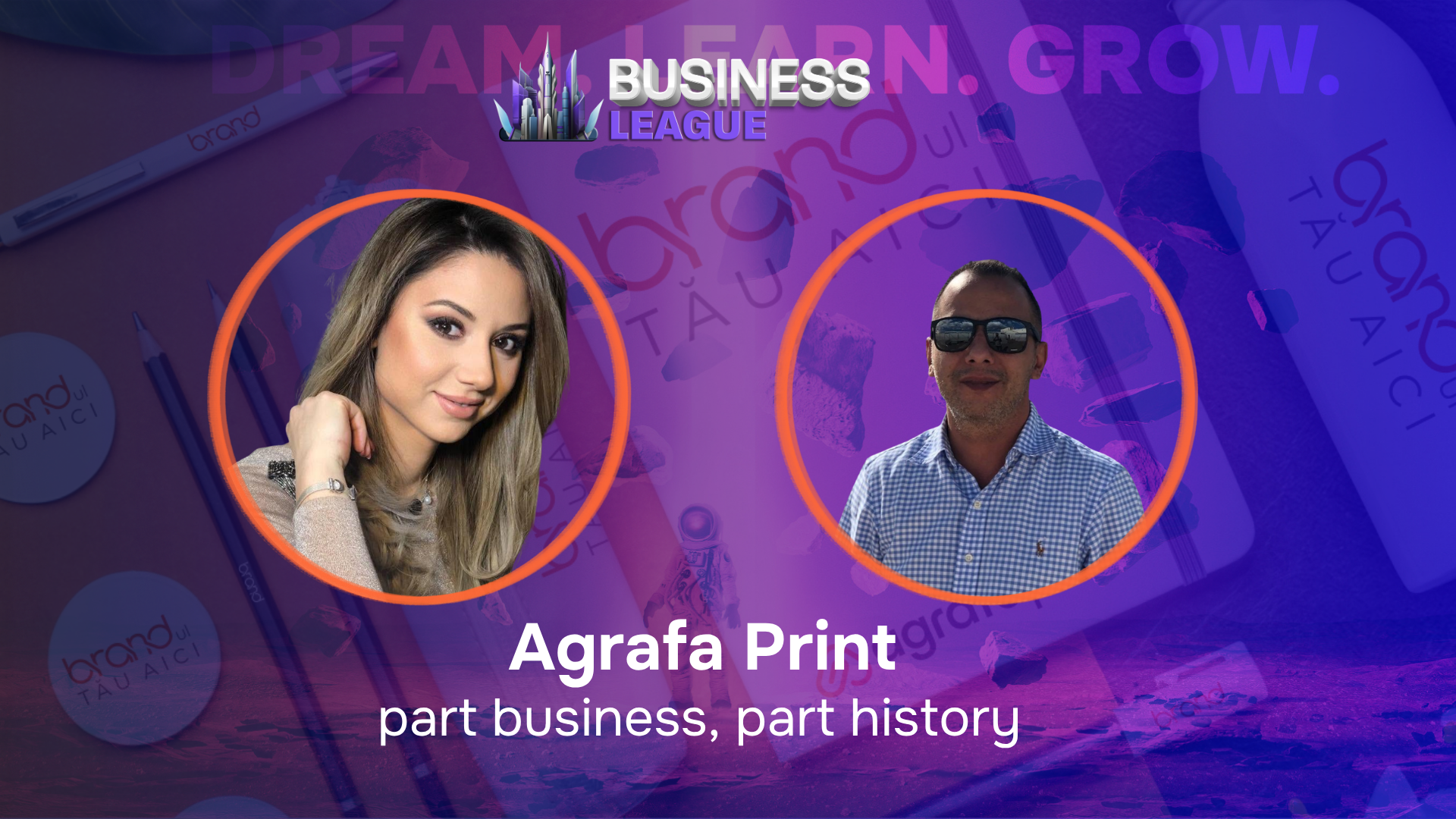
A few hundred metres from Obor, on a shady street with plenty of parking spaces, people work both with their hands and with cutting-edge technology. The street is called Dragoș Vodă, and the place is Agrafa Print.
It sits right next to Calea Moșilor, the old Podul Târgului de Afară, or the Outer Market Bridge (it was called a bridge, but it was actually a road, the first one in Bucharest paved with stone, in 1825). As early as the 17th century, Bucharest's merchants and craftsmen carried their goods along this road to the market at the edge of the city.
Craft and trade are also what I came to see at Agrafa, one of the oldest digital printing and advertising production businesses in Romania. I was welcomed by the duo Laura and Mihai Baciu, who have worked side by side for 12 years in the old boyar house at 44-46 Dragoș Vodă.
A great many people and things have come together over all this time, and I tried to learn a small part of their story.
About the company
Today, around 40 people work at Agrafa. The building at the front houses the "desk people": accounting and graphic design. Everything else happens at the back: sales, client service, printing, finishing.
A great many products are made here from scratch: everything to do with paper, from printing to cutting, folding, gluing and binding. Whatever is printed is also finished here, and some products start, as I said, literally from zero: name badges, for example, begin as a piece of plastic that the craftsmen cut, print and fit with a magnet or a pin.
So, alongside Mihai, I squeezed past thousands of products and dozens of machines of every kind, through rooms on three floors packed with boxes and projects in progress, which is to say, truth be told, through their investment of several hundred thousand euros.
The products
If you can put a logo on it, chances are Agrafa can make it for you.
There are currently more than 20,000 products on the website. Their search works well, so I found business cards (from standard ones to plastic or metal, embossed or foiled), corporate print (flyers, leaflets, brochures, magazines, presentation folders), materials for shops and restaurants (menus, table tents, shelf promotion, loyalty cards), stickers and labels (including domed resin ones, the kind you see on machinery and tractors) and large-format print (banners, roll-ups, floor and window graphics, wallpaper, canvas prints).
For events they have name badges, lanyards, pin badges, trophies and diplomas. For the office, there are of course the evergreens: pens, notebooks, USB sticks, power banks. And last but not least, textiles (T-shirts, hoodies, caps, workwear), plus packaging: paper bags, cardboard or wooden boxes, even custom adhesive tape.
"We have presses for everything," Mihai told me in one of the workshops. I asked him which products sell best, and he said anything to do with "drinkware": mugs, thermoses and sports bottles are consistently among the ten most requested products.
A conversation with Laura Baciu, Head of Sales
They started with a handful of people making business cards as their main product. Now there are 40 of them and more than 20,000 products on the website.
As for AI, they were sceptical at first; now, Laura says, they are "slightly addicted" to it. A concrete example: a complex client request, for which they used to spend 4–5 hours searching for products on their own website, is now solved quickly with AI.
The rest of the conversation is on BusinessLeague.com's social media channels.
Investments and philosophy
In the workrooms you'll find machines of all ages. The digital press, for example, is a year old. The sublimation machine arrived a month before my visit. The Japanese cutting machine, Mihai told me, "costs as much as a studio flat": it reads the barcode on each job and reprograms itself. It knows where to cut, where to fold and where to perforate, and when another order comes in, it rearranges its blades and carries on.
Technology has always been extremely important in a printing business.
In the past, someone had to leaf through the stack of printed sheets and only discovered at the end that half of them were ruined, and the card stock ended up in the bin. Now the machine scans every sheet by itself and stops if something isn't right. The operator hits print, walks off calmly, has a cigarette, and comes back to find everything printed perfectly.
I left knowing when I'll be back: sometime in spring, when Agrafa holds its annual get-together with partners, clients and friends. I'll have a beer with them and they'll count me among their friends by default.
(note: this article was translated form Romanian using AI)